Administration and Program Operations
- Historically, producers have paid 70 percent or more of the eradication program's operational costs. Some states have contributed to assist this producer-led effort. Federal funds covered the remaining expenses, including overhead and capital equipment.
- Operations, oversight and administrative services of the eradication programs are provided by various regional/grower or state/grower managed eradication foundations.
- APHIS manages federal program activities and provides technical assistance for cooperating grower organizations. USDA's Agricultural Research Service, APHIS' Center for Plant Health Science and Technology, state universities and experiment stations develop technology to maximize program effectiveness and efficiency.
- Decisions are made cooperatively by all partners, grower boards, USDA/APHIS and state agriculture department representatives.
- Through its Boll Weevil Action Committee, the National Cotton Council provides coordination to the efforts of state and federal agencies and grower organizations with the goal of seeing a weevil-free U.S. Cotton Belt during this decade.
Eradication Components
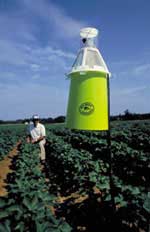 |
| Plastic traps with a screen-wire insert and dispenser holding a weevil attractant are checked each week from early spring to killing frost to monitor boll weevil populations. |
- Boll weevil eradication is accomplished by a combination of tactics, including insecticide applications, destruction of harvested plants and trapping with the use of pheromones. Trapping also is the key element in monitoring determining which fields require chemical applications and monitoring for re-infestations.
- Chemicals are applied as needed from late summer until harvest to kill the maximum number of weevils before they achieve diapause, a biological state essential to their winter survival.
- Defoliation of plants and stalk destruction as soon as possible after harvest effectively eliminate food and shelter for surviving weevils.
- Much of the success of eradication operations can be attributed to the synthetic pheromone trap. The traps capture weevils that have survived stalk destruction and spraying as well as help protect eradicated areas by detecting individual weevils that find their way into the area.
Post Eradication
- Once a state has completely eradicated the boll weevil, the activities shift to post eradication efforts. Pheromone traps are utilized to continue monitoring for boll weevil re-infestations. Areas must maintain an active monitoring program to prevent rare incidental reintroduction from becoming a reproducing expanding population.